
The End of Life of Oracle Agile 9
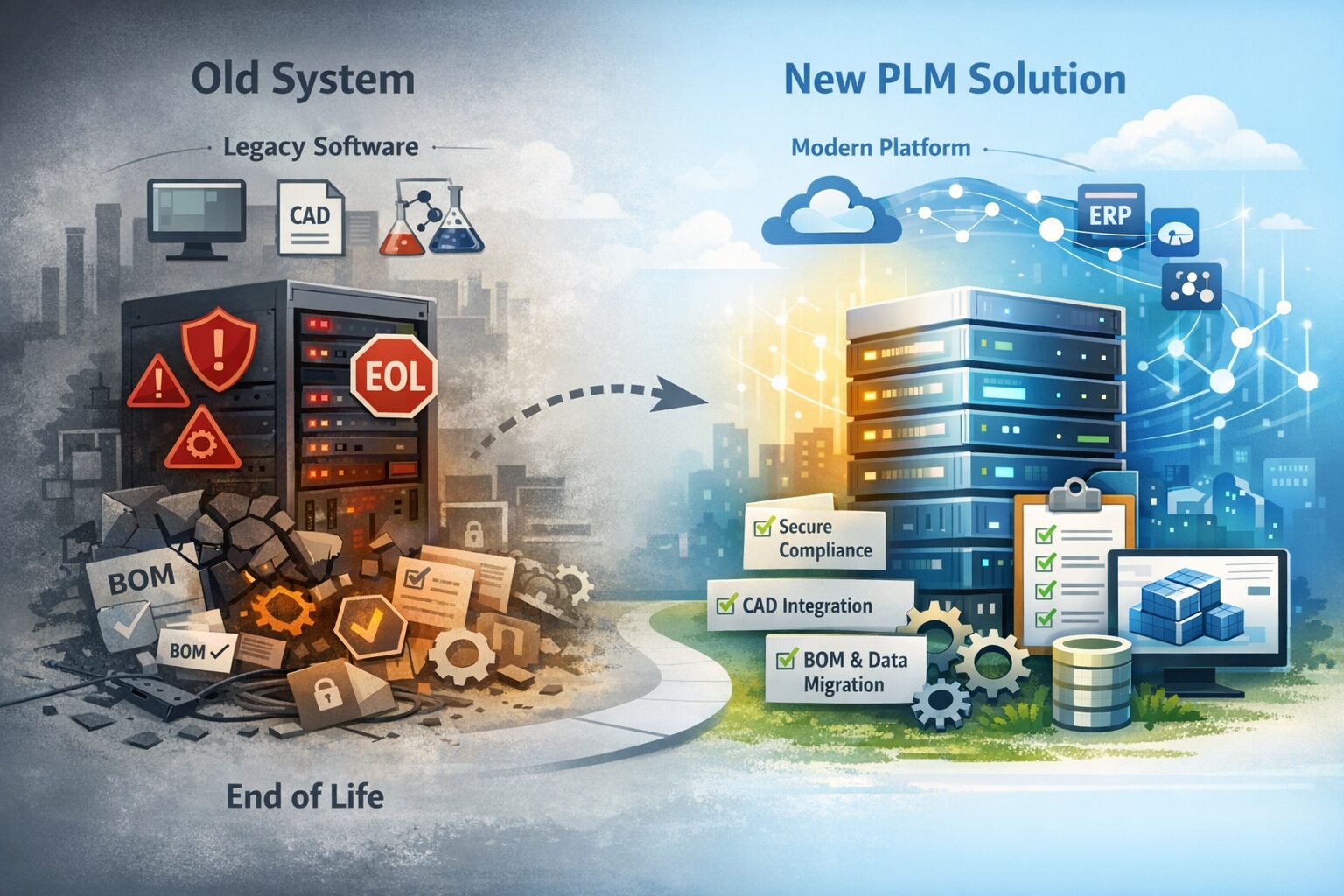
The end of life of Oracle Agile 9 – what does it mean in practice?
In many companies, Oracle Agile 9 is still a core system for managing product data, change control and traceability. It has served reliably for many years, particularly in environments where approval processes, audit trails and controlled workflows are important.
When the system reaches end of life and vendor support is withdrawn, the situation changes in a fundamental way. Delaying the renewal decision increases risk over time. Once vendor support, fixes and security updates are no longer available, the question becomes how the system can be kept secure, maintainable and compliant with regulatory requirements in the years ahead. This is not just an IT issue.
What does end of life mean in practice?
An unsupported system may remain in use for quite a long time, but the technical and business environment around it continues to change. Operating systems, databases, integrations and security requirements evolve, even if the PLM system itself stays the same.
This typically leads to three practical problems:
- Maintenance becomes more difficult, and dependence on individual specialists increases.
- Security and audit risks grow because fixes are no longer available.
- It becomes harder each year to justify the system as part of the company’s IT and business architecture.
So the issue is not usually whether the system still works today, but how long its continued use can be managed at an acceptable level of risk.
What are the main concerns?
For most Agile 9 customers, the main concerns fall into four areas.
- Security and compliance risk
In regulated industries and audit-sensitive environments, the issue is not only functionality. Organisations increasingly need to answer whether the system is still supported, whether it receives security updates, and whether the platform still meets current requirements. - Preservation of processes and customisations
In many companies, Agile has accumulated years of process logic that has not been fully documented elsewhere. This may relate to BOM structures, change management, CAD integrations or specification management. As a result, there is often a justified concern that critical practices may be lost or oversimplified during a system replacement. - Data integrity and traceability
A PLM migration is not just a database transfer. If change history, audit trail, document relationships or version history are not transferred in a controlled way, the result may be both operational problems and audit-related gaps. - Cost and project risk
Many mid-sized companies are concerned not only about the price of a new system, but also about a project that drags on, overloads key people and disrupts day-to-day operations. For that reason, realistic phasing and clear scope are often more important than an ambitious large-scale transformation.
How should companies prepare in a controlled way?
A successful transition usually begins with an assessment of the current situation, not with choosing a new system. The first step is to identify which processes, integrations and data content are genuinely critical to the business, and which can be simplified, redesigned or archived if necessary.
In practice, sound preparation should include at least the following questions:
- Which Agile 9 functions are critical to day-to-day business operations?
- Which customisations support a real business need, and which are simply the result of historical development?
- What integrations exist today with ERP, CAD, quality management or supplier processes?
- What information must remain operationally available, and what can be archived?
- What requirements do security, audit and regulation place on the future solution?
This stage reduces uncertainty and helps build a roadmap that fits the company’s resources. In mid-sized organisations, this is often crucial, because a PLM initiative usually has to be carried out alongside normal business operations rather than by a large dedicated programme team.
Who should be involved?
Replacing Agile 9, or planning its controlled phase-out, is not just an IT project. It is important to involve both business and technical stakeholders early enough.
The key participants typically include:
- Product development leadership, to assess the impact on lead times, collaboration and change management.
- Product development and engineering teams, who understand BOMs, CAD processes, item structures and working practices around engineering change.
- IT, which is responsible for security, integrations and maintainability.
- Representatives from quality management, procurement or supply chain, and where relevant, people responsible for regulatory matters or risk management, if the system is important for audits, compliance or supplier-related processes.
When these perspectives are included from the start, decision-making is based not only on software features, but on how well the future solution supports the operating model as a whole.
Summary
The end of life of Oracle Agile 9 does not mean an immediate crisis, but it does mean growing technical and operational debt. The longer the decision is postponed, the more dependence grows on the old environment, individual specialists and workaround arrangements.
The companies that tend to succeed are those that move forward calmly but systematically:
- They identify the critical processes.
- They define the scope of change correctly.
- They keep day-to-day product development stable during the transition.
Fulvisol’s perspective
For companies evaluating their next steps after Oracle Agile 9, the most important first step is usually not choosing a new system. A more practical starting point is to form a clear view of the current risk level, the business-critical processes and the realistic paths forward.
Fulvisol can support this stage in particular through current-state assessment, transition planning and clarifying the PLM strategy before any final technology decisions are made. This kind of approach helps companies make decisions in a controlled way, even when internal resources are limited.