
PPWR is a product data problem first
The EU packaging regulation, PPWR, has applied since 12 August 2026. That was a few weeks ago. What is striking is how little changed inside affected companies on that day - not because the regulation is toothless, but because the obligation that bites first does not require new packaging material.
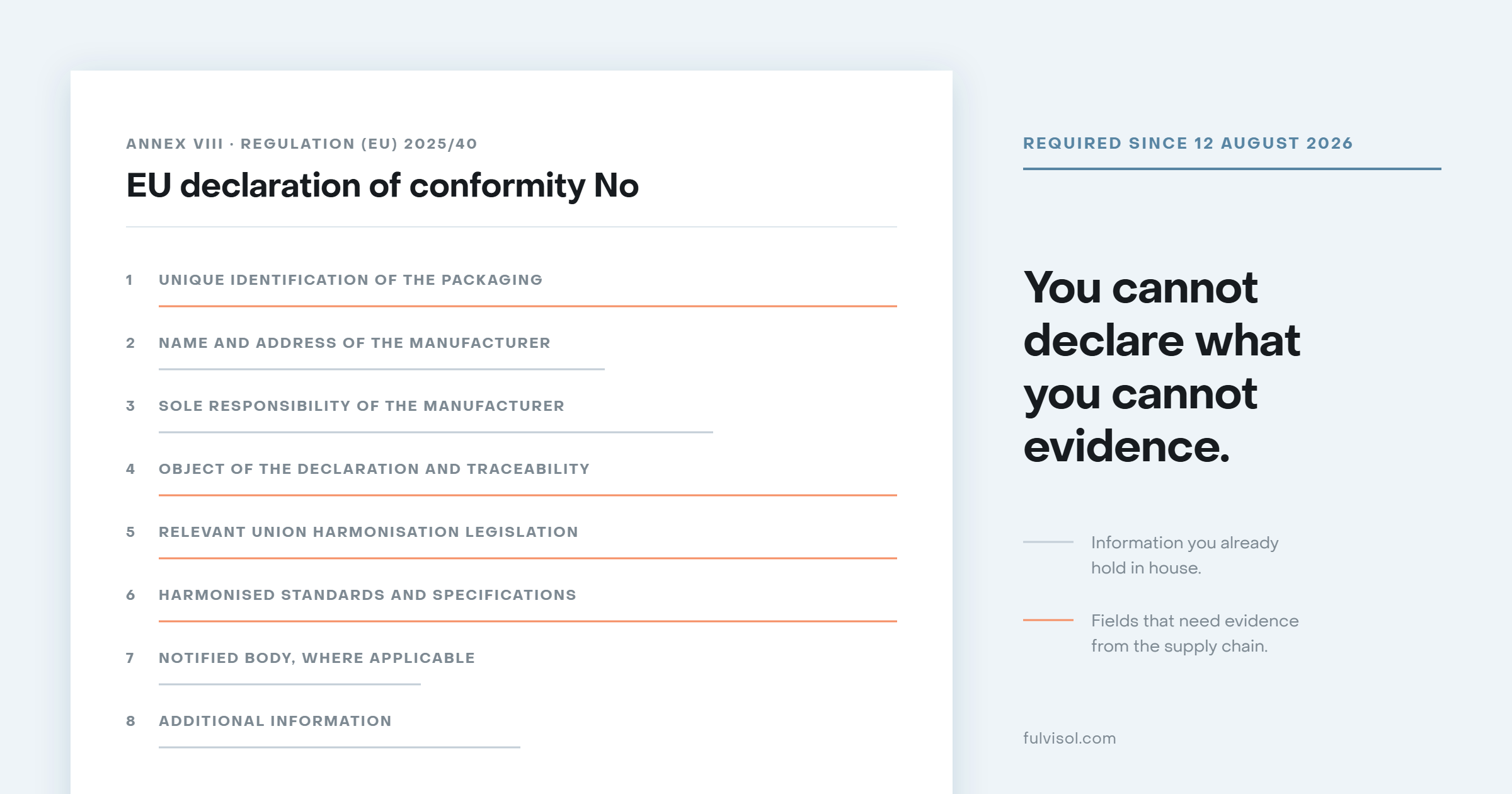
The regulation asks for proof. Anyone placing packaging on the market must draw up and keep an EU declaration of conformity: a signed statement that this particular packaging meets the requirements. You can only declare what you can evidence. And you cannot evidence what sits in an Excel sheet nobody has versioned and nobody has approved.
PPWR regulates the gathering of data before it regulates packaging.
Four obligations, four data requirements
The declaration of conformity is a state, not a document. It is drawn up per packaging type and has to be kept up to date. Underneath it sits the technical documentation: a description of the packaging, its construction, drawings, the materials of each component, test reports. Both must be kept for five years for single-use packaging and for ten years for reusable packaging. Authorities check a sample of declarations for accuracy every year.
What that needs is a complete, versioned, auditable packaging specification per trade item, linked to the product inside it.
Recycled content and recyclability are bill-of-materials calculations. From 1 January 2030, plastic packaging must contain a minimum share of recycled material: 30 per cent for food-contact packaging made mainly from PET, 10 per cent for food-contact packaging from other plastics, 30 per cent for single-use plastic beverage bottles, 35 per cent for all other plastic packaging. It is not calculated per item but as an average per plant per year. That is a report, not a master data field.
Separately, every pack gets a recyclability grade: A at 95 per cent recyclable or more, B at 80 per cent or more, C at 70 per cent or more. From 2030 only A, B or C may be placed on the market; from 2038 only A or B.
What that needs is material composition at the level of packaging component and material layer, declared by the supplier, backed by certificates - and every certificate carrying an expiry date.
The substance limits roll up from the bottom. Lead, cadmium, mercury and hexavalent chromium must not exceed 100 mg/kg in total. For food-contact packaging, three PFAS limits have applied since 12 August 2026: 25 ppb for any single substance, 250 ppb for the sum of all measured PFAS, and 50 ppm for total PFAS including polymeric PFAS.
The interesting part is how the regulation organises the proof. If fluorine content exceeds 50 mg/kg, the packaging supplier must, on request, show how much of it is PFAS - so that the manufacturer can compile its own technical documentation. Elsewhere the regulation states the same idea in general terms: suppliers must give the manufacturer every piece of information and documentation needed to demonstrate conformity.
What that needs is substance data from the supply chain, rolled up through components to the finished trade item. It is the same arithmetic as allergens and nutrition, applied to the pack instead of the recipe.
Using less material is a question of dimensions, not of materials. Packaging with double walls, false bottoms or unnecessary layers is already prohibited. From 2030 the real minimisation duty arrives: weight and volume reduced to what protection, handling and safety actually require. Alongside it comes an empty space ratio - the proportion of air in grouped, transport and e-commerce packaging - capped at 50 per cent.
What that needs is weight, volume and dimensions maintained as engineering data. Not as figures someone once typed into an artwork brief.
Four obligations, one shared trait: each starts as a product data question early in product development and surfaces as a document at the end of the development chain.
Where it falls apart today
In a company with a few hundred to a few thousand items, the picture is usually this. The recipe is in the PDM system. The packaging is in a separate specification tool, or in Excel. The artwork is with the agency. Supplier certificates are on a shared drive and in an inbox. The ERP holds a packaging weight nobody has revalidated since 2019. And the PIM publishes to the retail data pools whatever was last entered by hand.
Individually, none of this is wrong. Each system does what it was bought to do. Together they cannot do two things: produce a defensible declaration of conformity at scale - and produce it again, for last year's pack, when an authority asks. The second case is the uncomfortable one. It does not call for diligence. It calls for reconstruction.
What changes with PLM
Packaging becomes an object in its own right. In the same structure as the recipe: product → trade item → packaging → component → material → supplier. Not an attachment to the item, but a record with its own bill of materials.
Calculate instead of re-entering. Recycled content, weight and restricted substances roll up the packaging BOM exactly as nutrition and allergens roll up the recipe BOM. Change your film supplier and you are not editing just one figure in one place - the recyclability of every affected item is recalculated.
Supplier data captured at source. The external user base is far too large to license into the platform; it runs to hundreds or thousands of contacts. So suppliers work in a portal, and their submissions are written back into the platform through a purpose-built interface. Certificates and declarations are then attached to the object, with validity dates and automatic blocking on expiry. Not to an email thread.
Where-used analysis. "Which of our 1,400 items use this laminate?" is the question every PPWR transition project actually hinges on. In a structure with a bill of materials, that is a query. In a file share, it is a project.
Versioning and change history. The declaration of conformity has to be retained and, if challenged, defended. Defending it means reproducing the data as it stood at the time. For a PLM system that is routine. On a shared drive it is effectively impossible.
One source, several outputs. The same governed data feeds the declaration of conformity, the producer-responsibility return, the attributes sent to retail, the label and the CO₂ report. The alternative is four departments each maintaining their own version of the truth and reconciling once a quarter.
Packaging cost becomes predictable. Under extended producer responsibility (EPR), producers pay for the disposal of the packaging they place on the market. Those fees will be eco-modulated - tiered by environmental performance, so poorly recyclable packaging costs more. They only become formally tied to the recyclability grades around 18 months after the outstanding EU implementing rules take effect, realistically in 2029 or 2030. Wait until then and you will learn your grade from an invoice. Hold the material composition in a structure today and you can model the grade at the concept stage. That is the real shift: PPWR pulls packaging decisions upstream into product development. That is where PLM lives.
What we see in the market
PPWR, EPR and CO₂ now appear as mandatory blocks of their own in food-industry tenders for product data systems. In a recent tender from a European biscuit manufacturer, PPWR is a numbered requirement with ten sub-items - the largest block of genuinely new scope compared with what the established systems in this industry were built to do. Asked whether they expected the system to supply the recyclability and CO₂ data or to calculate it, the buyer was unambiguous: calculate it, from the supplier data held in the system.
The counter-example is worth noting. A requirements list from a southern European food manufacturer never mentions PPWR at all. It does ask for packaging checked against target-market requirements, for material composition and recycling data owned by a named role, and for a footprint figure per item. Same data, different vocabulary. The requirement arrives whether or not the regulation is named.
Five questions for your next internal meeting in manufacturing
- Can you produce a complete packaging specification for any item, as at any past date, without asking three departments?
- Do you know today which of your items would land in the lowest recyclability grade?
- Does the person who needs to know see a supplier certificate expiring before it expires?
- Where does your packaging weight actually live - and who last verified it?
- How many places in your organisation maintain the same packaging figure independently of each other?
PPWR does not punish bad packaging. It punishes packaging you cannot evidence.
This article is for orientation only, not legal advice. Which obligations apply in practice depends on the packaging type, the target market and how individual Member States implement the rules. Several deadlines also depend on EU implementing rules that are still outstanding - the rules for harmonised labelling were due on 12 August 2026 and had not appeared by the end of August.
If you would like a view on how defensible your packaging data is today, we are happy to spend an hour on it. Read more about the Fulvisol Food + Beverage PLM package.
Sources
- Regulation (EU) 2025/40 (PPWR), EUR-Lex - application from 12 August 2026 (Art. 71); substance limits Art. 5; recyclability Art. 6 and Annex II Table 3; recycled content Art. 7; minimisation Art. 10; labelling Art. 12; supplier obligations Art. 16; empty space ratio Art. 24; declaration of conformity Art. 38/39 and Annexes VII, VIII
- European Commission - Packaging and Packaging Waste Regulation
- Commission guidance document C(2026) 2151 final and FAQ, 30 March 2026
- Gleiss Lutz - The new EU Packaging Regulation: key requirements from August 2026
- Packaging Europe - Commission misses deadline to harmonise PPWR labelling