
PLM: More Than a System
 Product Lifecycle Management – PLM – often enters a company as software. A new system, a new rollout, a new promise to “finally get control of product data.” And yet, years later, many organizations still struggle to answer basic questions: Which version is released? Why was this changed? Who depends on it?
That’s because PLM is not just a tool. It’s a way of organizing people, processes, and product data so that a product can be understood, traced, and managed – from the first requirement to the last unit in the field. In this context, a “product” can be a machine, a vehicle, a packaged food, a recipe, or even a service offering – anything that must be defined, approved, changed, and reproduced consistently at scale.
This is where confusion starts. PLM is both a system and a concept, and treating one as a substitute for the other is the fastest way to disappointment.
Let’s untangle them.
PLM the Concept vs. PLM the System
PLM as a concept is broader – and more important. It’s the idea that a product should be managed consistently, traceably, and coherently from the first requirement to the last spare part. Across departments. Across years. Across tools.
A PLM system is an IT platform. It stores product data, manages versions, controls access, and connects tools like CAD, ERP, and manufacturing systems.
The system enables the concept. It does not create it.
That distinction matters, because many companies buy a PLM system and then wonder why nothing really changes.
What PLM Actually Covers
In practice, PLM concept spans a set of tightly connected product pieces of information, including:
- Requirements – functional, regulatory, quality, or customer expectations
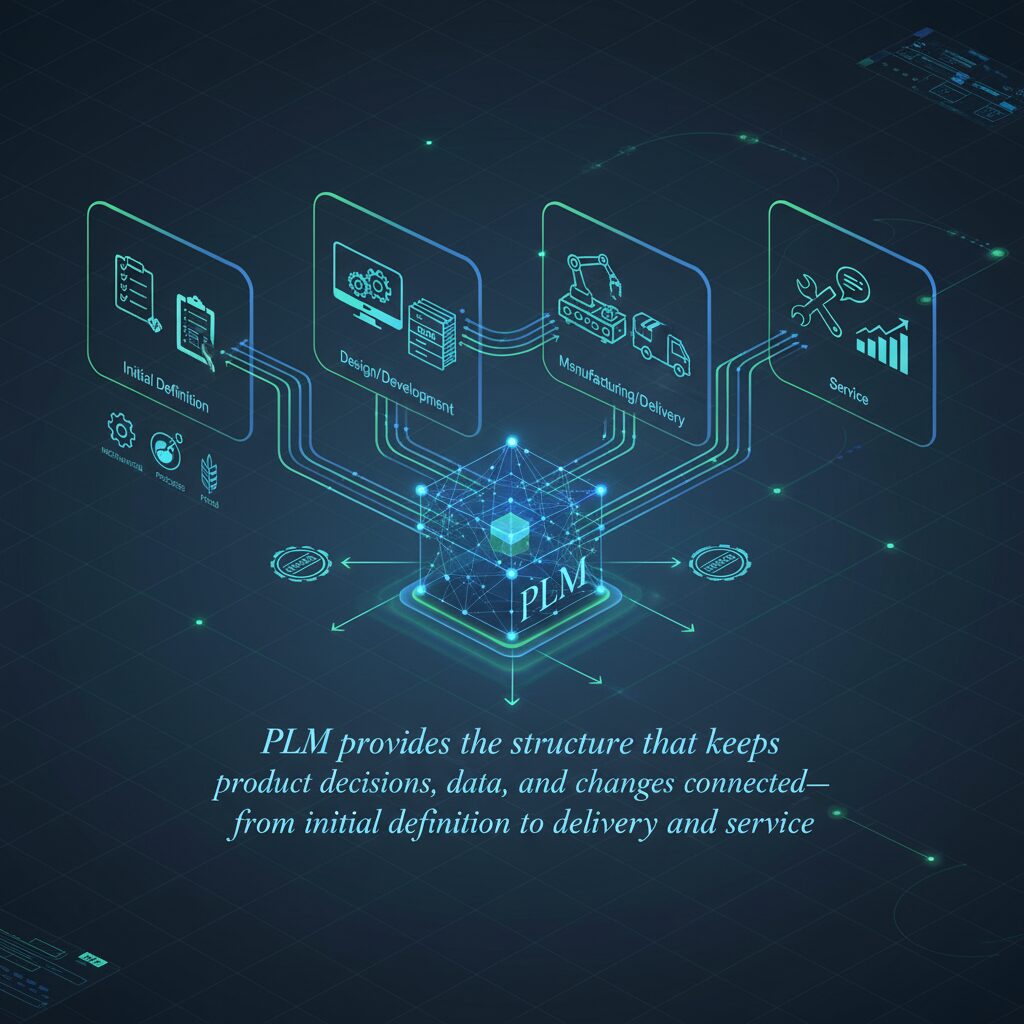
- Design & definition data – CAD models, formulas, recipes, specifications
- Parts & structures – components, ingredients, service parts
- Changes – controlled updates with impact on cost, quality, or compliance
- Tests & validation – simulations, lab tests, tastings, audits
- Manufacturing & delivery data – production lines, process plans, service plans
- Lifecycle & feedback – field data, complaints, recalls, continuous improvement
PLM is not about owning all this data. It’s about connecting it in a meaningful way.
PLM and the Digital Thread
This is where the idea of the digital thread comes in.
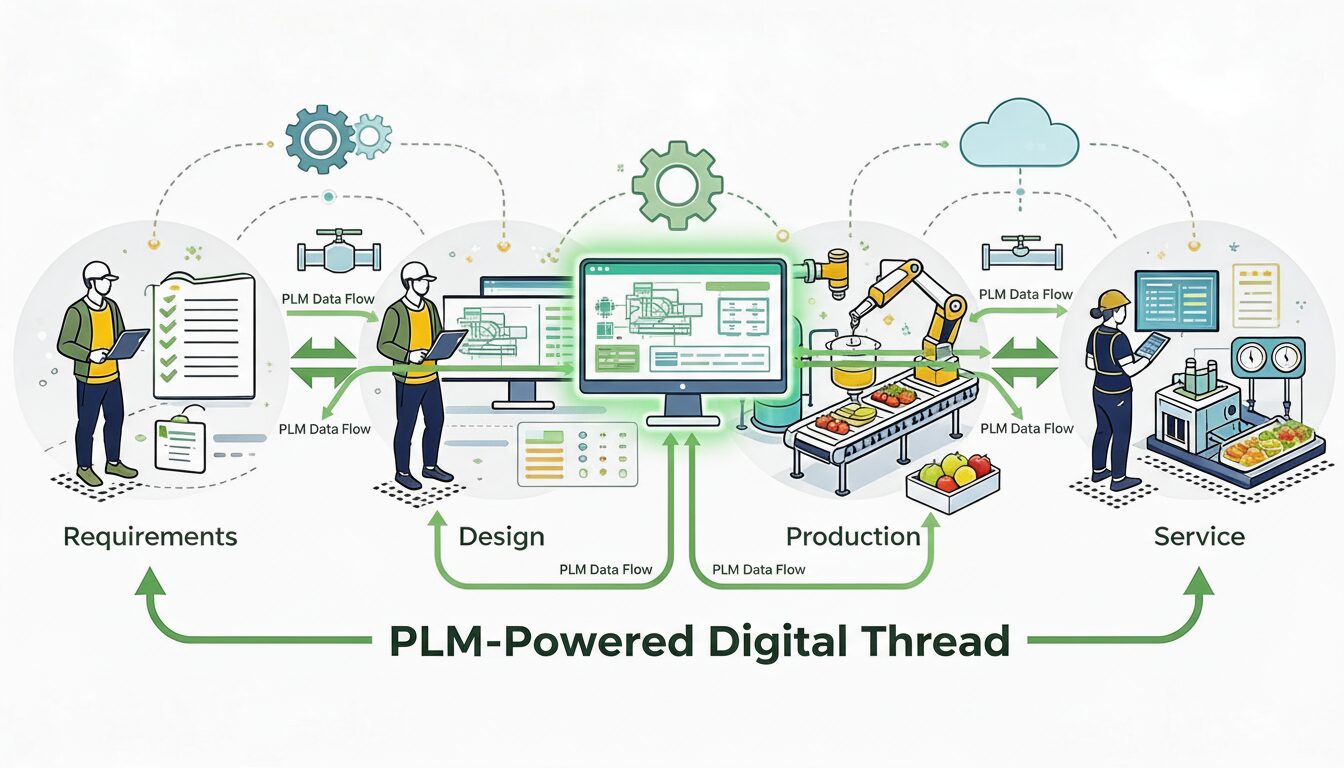
The digital thread is the storyline of a product: how a requirement leads to a design or formulation decision, which becomes a defined structure, which is produced, delivered, validated, and supported over time. Every step leaves a digital trace – and those traces are linked with each other.
PLM is the backbone that makes this possible.
Without PLM, data exists – but it’s fragmented. Requirements live in documents. Designs or recipes in local tools. Manufacturing and service data in ERP. Knowledge in people’s heads. The digital thread snaps every time information crosses a boundary.
With PLM done right, the thread stays intact.
The digital thread is not limited to a physical product – it is the traceable record of decisions, data, and approvals that explain why something is the way it is.
The Reality in Companies
Now for the honest part.
In the average company, PLM is rarely “fully implemented.” What you usually find is:
- A PLM system used mainly as a data repository
- Excel sheets filling the gaps between systems
- Change processes that work—until they don’t
- Engineers doing heroic manual coordination to keep operations moving
- Management assuming “the system has the data somewhere”
In engineering-heavy companies, this often shows up as CAD-centric PDM (Product Data Management).
In food, consumer goods, and service-driven industries, it looks different—but feels the same. Recipes or service definitions live in spreadsheets, quality rules in documents, production or delivery data in ERP, and critical knowledge in people’s heads. When regulations change, ingredients are substituted, or services are localized, keeping everything aligned becomes slow, manual, and risky.
This isn’t incompetence. It’s history.
Most organizations grew organically. Tools were added to solve local problems. PLM often arrived late, expected to magically integrate everything without changing how people work. That never happens.
Why PLM Still Matters
Despite this reality, PLM remains one of the most strategic capabilities a company can build. Not because it makes engineers happier (though it can), but because it:
- Reduces operational risk
- Improves decision-making speed
- Preserves knowledge beyond individuals
- Enables compliance and traceability
- Scales product complexity without chaos
In other words, PLM is not an IT project. It’s a business capability with technical consequences.
The Takeaway
PLM works when companies stop asking “What can the PLM system do?” and start asking “How do we want our product knowledge to flow?”
The system follows the concept.
The digital thread follows the system.
And clarity follows all three—when they’re aligned.
That’s PLM. Not shiny. Not simple. But absolutely worth getting right.